Spades Online - Card Game
- 4.6
- Rating
- 100.00K
- Installs
- Free
- Price

 Analysis by App-foxy
I tried Spades Online - Card Game as the kind of game I would keep nearby for short breaks rather than treat as a large, all-consuming hobby. It is a free card game from ZiMAD, built around Spades, with online multiplayer and solo play at its center. That combination makes the decision fairly simple: if you already enjoy bidding, partnership tricks, and the small tension of deciding how many tricks you can take, this is an approachable way to get a game going on a phone. If you want a broad collection of unrelated card games, a completely offline experience, or a very relaxed game with little strategic pressure, you may be happier elsewhere.
The game is listed for Everyone 10+, runs on Android 7.0 and later, and the current version is 3.0.1. It is free to install, although optional purchases range from $0.99 to $249.99 per item. That last point matters more than the word “free”: I could start without paying, but anyone who dislikes seeing purchase options in a game should approach it with that in mind.
How I Would Decide Whether It Fits
I use this section to turn the choice into a simple test of routine: whether I would reach for a focused Spades game after its first-week novelty has passed, not just when I happen to have time to try something new. I would pay attention to which mode I naturally open and whether I enjoy thinking through bids often enough to make that habit stick. That makes it easier to judge its staying power without mistaking an occasional good hand for lasting fit.
You May Also Like

 Blood Strike: 2.5 Anniversary
Blood Strike’s Loadouts Turn Every Drop Into a Tactical Gamble
A close look at Blood Strike’s custom loadouts: how fast access to signature weapons reshapes its battle royale rhythm, rewards preparation, and narrows the gap between fights.

 Pandora - Music & Podcasts
Pandora’s Music Is Easy to Start, but Harder to Recover
Pandora’s strength is its low-effort path from a seed to a station. Its weak spot is how much confidence it asks you to place in connection, setup, and quiet recovery.

 8 Ball Pool
 Is Built on Rivalries, Rematches, and Routine
A close look at the rivalries, rematches, shared routines, and unanswered safety questions that turn a quick pool match into a persistent mobile community.

 Samsung Music
’s Quiet Strength Is Playing What You Already Own
Its reach comes less from spectacle than from dependable access to a personal library. That simplicity is both the app’s strongest retention engine and its ceiling.

 AccuWeather: Weather Radar
AccuWeather Review: A Quick, Clear Forecast for Everyday Decisions
For everyday plans, the best forecast is the one you can understand quickly. AccuWeather makes rain timing, radar, and local conditions easy to act on, with a few trade-offs.

 Hill Climb Racing
Why Hill Climb Racing Still Turns Crashes Into One More Run
A tiny car, a bumpy hill and one more upgrade: Hill Climb Racing keeps resurfacing because its simple chaos makes every near-miss feel personal.
More From Our News Desk
View All News


The right question is what kind of card game you want
Spades is not a patience game where I can casually arrange cards while half-watching a show. The basic appeal comes from planning around a bid, reading the likely strength of a hand, and trying to take the tricks I promised without giving away too many opportunities to the opposing side. Even when the rules are familiar, each deal asks me to make a fresh judgment about risk.
That makes this a better choice for players who want a traditional trick-taking game than for people searching for a collectible card battler, a solitaire collection, or a fast matching puzzle. The category label “card game” covers a lot of very different experiences, and this one depends on understanding the rhythm of bidding and tricks. I would not recommend installing it simply because you enjoy cards in general; I would recommend it because you specifically like Spades or want to learn that style of play.
My first decision criterion is therefore familiarity. Experienced Spades players can get into a hand quickly, while newcomers may need a few rounds to understand why a conservative bid can be more valuable than an ambitious one. The game is accessible enough to learn through play, but the strategic consequences are not always obvious at the beginning. A player who expects every round to be instantly understandable may find the opening sessions a little demanding.
Solo or online play changes the experience
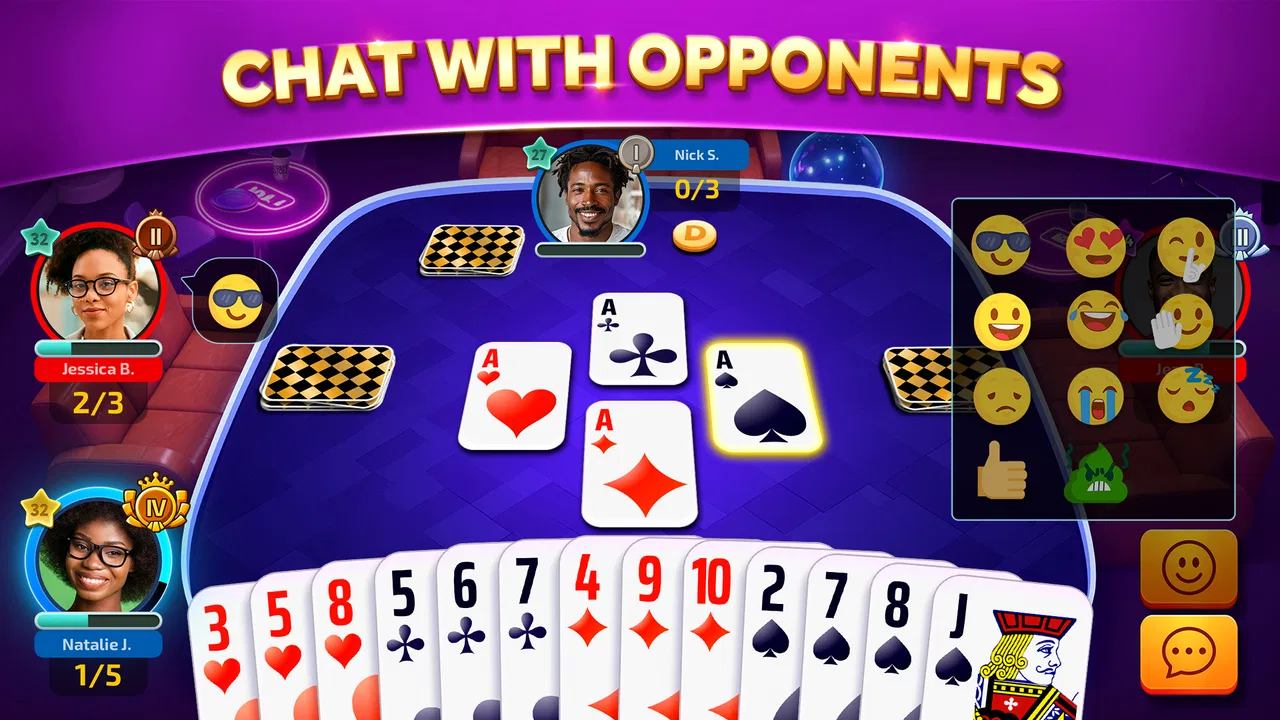
The choice between solo play and multiplayer is one of the most useful parts of the package. When I want a quieter session, playing alone lets me focus on the cards without waiting for friends to be available. When I want the social side of Spades, online play gives the game a stronger sense of occasion because every bid feels connected to another person’s decision.
For a quick everyday session, solo play is the practical option. Imagine having ten minutes before an appointment: I can open the game, play a few hands, and stop without coordinating with anyone. Online play makes more sense when I have a reliable block of time or when I am specifically looking for the unpredictability of human opponents. That distinction is easy to overlook, but it determines whether the game feels convenient or demanding on a particular day.
I also see multiplayer as the better test of whether Spades is really your game. Computer opponents can help with practice, but human play exposes the social and strategic elements that make trick-taking satisfying. A bid from another player can change the way I evaluate my own hand, and a mistake from either side can turn an ordinary deal into a memorable one.
What I look for before committing
Before choosing this over another card game, I would consider four practical questions. Do I want Spades rather than several card formats? Do I value online play enough to accept that the experience depends on other players? Am I comfortable with a free game that includes optional purchases? And will I mostly play in short sessions, or do I want a long-form game with a deeper progression system?
Those questions are more useful than simply looking at its rating. The game has a 4.7 average from around 6.3 thousand ratings, with roughly 1.3 thousand written reviews, and it has passed 100 thousand installs. That suggests a healthy level of interest, but popularity does not remove the need to match the game to your habits. A strong rating cannot make a Spades player out of someone who dislikes trick-taking.
Where the focused design helps
What I like most is that the game has a clear identity. It is not trying to be a huge shelf of card formats. The focus means I can return to the same rules and improve my judgment instead of repeatedly learning a new system. For players who already know the game, that focus reduces friction: I can spend my attention on the hand rather than on discovering what the objective is.
This also makes it suitable for gradual improvement. One useful habit is to review the result of a hand mentally before starting another: Was my bid too optimistic? Did I spend a high card too early? Did I fail to account for the likely distribution of suits? Even without turning the session into serious study, that small pause makes the game more rewarding than simply tapping through deals.
Another non-obvious strength is the way solo and online play can support different learning stages. I would use solo sessions to become comfortable with the pace and basic decisions, then move to multiplayer when I wanted more uncertainty. That is a better workflow than jumping directly into online games while still trying to remember the fundamentals.
Useful habits for better hands
My main advice is to treat the bid as a promise, not a guess. New players often count only their strongest cards and ignore how difficult it may be to regain the lead after those cards are gone. I get better results when I consider the whole hand: the length of each suit, possible voids, and whether my weaker cards are likely to force me into unwanted tricks.
I also avoid spending a powerful card merely because I can. In Spades, timing matters. A high card may be more valuable later, when I need to control a trick or protect a bid, than at the first convenient opportunity. This is the sort of lesson the store summary cannot communicate, and it is where the game becomes more interesting than a simple luck-based card app.
For online sessions, I would keep communication and expectations simple. The game is easier to enjoy when I treat each hand as a small decision-making exercise rather than as a personal test. A bad deal or a missed bid is part of the format. If I become frustrated by every lost trick, the competitive side will overshadow the reason I opened the app.
Where alternatives may fit better
The usual alternatives fall into several groups. A solitaire app is better if I want complete control over the pace and no dependence on another player. A digital collection of classic card games is better if I want to switch between different rules in the same session. A collectible or deck-building card game is better if I want long-term customization, distinctive cards, or a progression loop rather than traditional hands.
I would also choose a different option for a family member who wants the simplest possible card activity. Spades has a learning curve because the bid, partnership expectations, and trick order all matter. A simpler matching or solitaire game can be more welcoming for someone who wants to play without learning a strategic vocabulary.
On the other hand, many alternatives lose the specific tension that makes Spades work. A casual card collection may offer more variety but less depth within one rule set. A puzzle game may be easier to start but does not provide the same satisfaction of making a prediction and then trying to fulfill it. If Spades is the part you care about, switching to a broader app can feel like gaining quantity while losing focus.
The trade-off of free access and purchases
Because the game is free, the initial commitment is low. I can try the solo and online sides before deciding whether the format deserves a place on my phone. That is helpful for newcomers who are unsure whether they enjoy Spades, and it also makes the game easy to recommend to a friend who does not want to buy an app just to test it.
The trade-off is the presence of in-app purchases. The available items span from $0.99 to $249.99, so I would not describe the financial side as something to ignore. The sensible approach is to decide in advance whether I am willing to spend anything, then keep the free experience as the default if I am not. A player who feels pressure to purchase in order to enjoy a game should be cautious, even when the download itself costs nothing.
This is also where the cost of switching matters. If I move from a paid, offline card app, I may be exchanging a simpler ownership model for a free-to-start game with optional spending. If I move from another online Spades game, the rules may feel familiar, but I still need to rebuild my routine and become comfortable with this app’s particular presentation and player environment. The switch is easy technically, but the real cost is learning whether its style suits me.
Who will get the most from it
I think the strongest audience is someone who already knows the basics of Spades and wants a convenient mobile version with both solo and online options. It also works for a curious beginner who is willing to learn through several hands rather than expecting immediate mastery. The game’s focused design gives both groups a clear reason to return.
It is especially useful for filling small gaps in the day. I can imagine playing solo while waiting for transportation, then saving multiplayer for an evening when friends are available. The two modes prevent the app from being useful only under one set of circumstances, which is a meaningful advantage over a game that requires a live opponent every time.
I would skip it if my priority is a completely purchase-free experience, a large variety of card formats, or a game with a substantial story and elaborate progression. I would also skip it if I dislike the uncertainty of online competition. No amount of polish can change the fact that Spades asks me to think about bids, partnerships, and trick control.
My final recommendation
After using it, I see Spades Online - Card Game as a focused recommendation rather than a universal one. It earns its place by staying centered on a classic trick-taking format and by offering the practical choice between solo sessions and online games. That is enough for me to recommend it to anyone who already enjoys Spades and wants a free way to play on a compatible Android device.
I would begin with solo play, use the first sessions to develop a more disciplined bidding habit, and only then decide how much online play fits my routine. I would also check my spending preferences before touching optional purchases. Those two steps make the experience clearer and reduce the chance of judging the game for the wrong reasons.
For me, the deciding point is simple: if the thought of estimating tricks, protecting a partner’s bid, and waiting for the right moment to use a strong card sounds enjoyable, this game is worth trying. If I would rather relax with solitaire or jump between many kinds of cards, another app is likely the better choice. Its 4.7 average and growing install base make it easy to take seriously, but the real reason to download it is more personal: it gives Spades players a direct, flexible way to turn a short break into a thoughtful card session.
FAQs for Spades Online - Card Game
01What is Spades Online - Card Game and how does it work?
Spades Online - Card Game is a digital version of the classic card game, Spades. It allows players to connect with others globally or play against AI. The game involves strategic bidding and trick-taking, where partners work together to fulfill their bid while preventing opponents from achieving theirs.
02Can I play Spades Online - Card Game with friends?
Yes, Spades Online - Card Game offers multiplayer options, allowing you to invite friends to join a game. You can create private tables or join public ones, making it easy to play with friends or meet new players from around the world.
03Is Spades Online - Card Game free to play?
Spades Online - Card Game is free to download and play, but it may offer in-app purchases. These purchases can include additional features, cosmetic items, or game currency to enhance your gameplay. However, you can enjoy the core game without spending money.
04What platforms is Spades Online - Card Game available on?
Spades Online - Card Game is available on both Android and iOS platforms. You can download it from the Google Play Store for Android devices or the Apple App Store for iOS devices, allowing you to enjoy the game on a wide range of smartphones and tablets.
05Does Spades Online - Card Game require an internet connection?
While Spades Online - Card Game offers offline play against AI opponents, an internet connection is required for multiplayer features. Connecting to the internet allows you to join online games, participate in leaderboards, and engage with the game's community features.
Pros
- Smooth and intuitive gameplay interface.
- Wide range of multiplayer options.
- Customizable game settings.
- Regular updates with new features.
- Low data consumption during play.
Cons
- Occasional connection issues.
- Ads can be interruptive.
- Limited offline play modes.
- In-app purchases can be pricey.
- Some features require account registration.

Spades Online - Card Game
Gallery